Greene and Greene Stained Glass Houston: Climate Adaptation Strategies
When the brothers Charles and Henry Greene pioneered their California bungalow aesthetic in the early 1900s, they built stained glass into the very bones of their homes — not as decoration applied after the fact, but as integral elements that shaped how light moved through a space. That same philosophy drives how we approach Greene and Greene stained glass Houston projects today, only we face a challenge the originals never encountered: Gulf Coast humidity that averages 75 percent and regularly spikes above 90 percent on summer mornings.
The Arts and Crafts movement championed honest materials and handcrafted detail, and the Greene brothers’ interpretation of it — with its deep appreciation for wood joinery, art glass, and Japanese-inspired proportions — remains one of the most beloved architectural styles in America. You can read more about the firm’s history and lasting influence in this overview of Greene and Greene’s architectural legacy, which traces their work from Pasadena bungalows to the iconic Gamble House completed in 1908.
What Makes Greene and Greene Stained Glass Distinctive
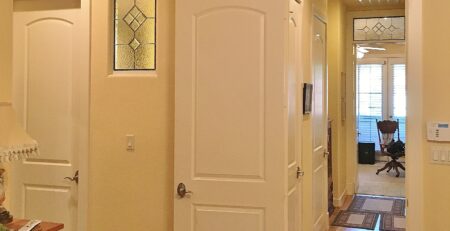
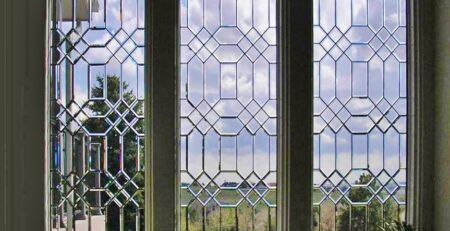
Greene and Greene glass is not about bold pictorial scenes or jewel-toned cathedral windows. It is about restraint, geometry, and the interplay of textured clear and subtle colored glass set into fine lead lines. The aesthetic draws from Japanese design principles — asymmetry balanced by harmony, negative space given as much weight as the glass itself. Every piece feels intentional, never ornamental for its own sake.
That minimalism is exactly why the style translates so well to Houston homes. In neighborhoods like The Heights and Montrose, where Craftsman bungalows and early twentieth-century cottages still line the streets, Greene and Greene-inspired panels complement the architecture without overwhelming it. We have written before about specific places where Greene and Greene stained glass looks exceptional in Houston homes, and that guidance still holds — entryways, sidelights, interior doors, and transoms all benefit from the style’s quiet sophistication.
Houston’s Climate Challenge for Leaded Glass
Here is where things get complicated. Houston’s average relative humidity hovers around 75 percent, with early morning levels regularly exceeding 90 percent. That moisture load is dramatically higher than what the original California installations ever faced. Humidity affects stained glass in several ways: it accelerates oxidation of lead came, encourages corrosion of solder joints, and can cause condensation to form between glass layers or behind protective glazing. Over time, repeated wet-dry cycling stresses the cement that holds lead joints together, leading to loosening and eventual panel bowing.
None of this means Greene and Greene glass cannot work in Houston — it absolutely can, and does, in homes across River Oaks, Memorial, and beyond. But it does mean that we treat every panel as a climate-specific engineering challenge, not just an aesthetic one. The difference between a panel that lasts decades and one that needs repair in five years often comes down to decisions made during fabrication and installation.
Climate Adaptation Strategies We Use
When we design Greene and Greene-inspired panels for Houston homes, we build in several layers of climate resilience without altering the style’s visual character:

Our first consideration is lead came profile and alloy. We select came with adequate structural depth for the panel size, and we reinforce larger panels with copper rebar at regular intervals. This prevents the bowing that Houston’s thermal cycling — from air-conditioned interiors to sun-baked exteriors — tends to induce over time. The reinforcement is invisible from the front but adds years of structural life.
Second, we pay close attention to cementing. The putty that seals lead-to-glass joints is your panel’s primary moisture barrier. We use a cement formulation suited for high-humidity environments and apply it thoroughly, working it into every joint. This step is tedious, but it is the single most important factor in preventing moisture infiltration that leads to corrosion.
Third, for exterior installations, we often recommend protective glazing — a clear outer layer of tempered glass mounted with a ventilated airspace between it and the stained glass. This buffer zone dramatically reduces thermal stress and condensation exposure. The ventilation is critical: trapped air without airflow can actually accelerate damage by creating a greenhouse effect. We size the vent gaps to allow moisture to escape while keeping wind-driven rain out.
Fourth, we think carefully about glass selection. The original designs relied heavily on textured clear and slightly tinted glasses — ripple, granite, and seedy textures that catch and diffuse light. These glass types perform well in Houston because they do not depend on painted details that humidity can degrade over time. Where colored accents appear, we choose glasses known for their chemical stability in humid environments.
Where Greene and Greene Glass Works Best in Houston Homes
The style shines in locations where its linear geometry and textured clarity can interact with natural light. Entryways are the natural first choice — a Greene and Greene sidelight or transom panel transforms a front door from a threshold into a statement. Interior door panels bring the aesthetic deeper into the home, offering privacy between rooms while maintaining a sense of openness. Cabinet glass in kitchens and butler’s pantries echoes the built-in art glass that defined the original Greene and Greene interiors.
For a broader look at how different stained glass styles complement each other, our guide to stained glass styles we work with in Houston covers Prairie, Art Nouveau, Mission, and other movements that pair naturally with Arts and Crafts architecture.
Ready to Bring Greene and Greene Style to Your Houston Home?
If you are drawn to the quiet elegance of Arts and Crafts stained glass and want panels built to withstand Houston’s demanding climate, Houston Stained Glass is here to help. We design, fabricate, and install custom Greene and Greene-inspired panels that honor the style’s heritage while incorporating the structural and material choices that Gulf Coast conditions require. Every project begins with a consultation where we assess your space, discuss your design preferences, and plan the fabrication approach that will give you a panel that lasts. Contact Houston Stained Glass today to schedule your free consultation.