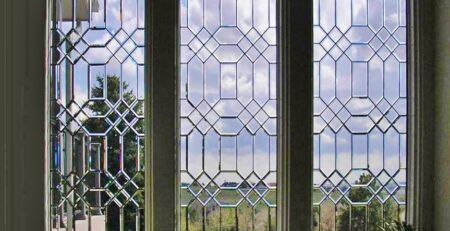
How We Fabricate Stained Glass Panels for Houston Clients
Every stained glass panel that leaves our studio begins as a conversation and ends as a hand-assembled piece of architectural art — one of the stained glass panels Houston clients trust us to build. Fabrication is where design, engineering, and craftsmanship meet, and it is the part of our work that clients rarely see. The stained glass panels Houston clients ask us for are always engineered around their window, so we measure before we design anything. We want to pull back the curtain on how we build panels for Houston homes, churches, and businesses — and why the way a panel is constructed matters as much as how it looks.
It Starts with a Design Built for Your Window
Fabrication does not begin with glass cutting. It begins with a design conversation. We visit your property, study the window’s architecture, measure its opening, and talk about how you want the space to feel. A panel for a bathroom privacy window needs to diffuse light differently than a panel for a grand entryway or a church sanctuary. Houston’s intense Gulf sun also shapes our choices: we plan glass selection and density so the finished piece delivers the color you want without turning a bright south-facing room into a greenhouse.
Once we understand the space, we create a full-scale cartoon — the working drawing that every piece of glass will be traced against. In this craft, precision at the drawing stage determines everything downstream, because each glass segment is cut to fit the cartoon exactly.
Choosing and Cutting the Glass
The glass itself is where a panel gains its personality. We work with hand-rolled art glass in hundreds of colors and textures, including cathedral glass, opalescent glass, and textured glass that mimics ripples and folds. For a client in a Houston Heights craftsman bungalow, we might lean toward warm, earthy tones with beveled accents. For a contemporary home in The Woodlands, clean geometric lines in jewel tones might fit better. The client’s architecture always leads; the glass follows.
Cutting comes next. Each piece of glass is scored and shaped by hand, then refined at the edges so it fits its neighbor with hairline precision. Curves are the hardest part — a well-cut circle or petal shape is a quiet signature of a skilled cutter. When clients ask how we can match an ornate design to a photograph, the answer is patient, repeatable cutting, one piece at a time.
Two Assembly Methods We Use
There are two traditional ways to assemble a stained glass panel, and we choose between them based on the panel’s size, location, and design.
- Lead came assembly: Each piece of glass is set into H-shaped strips of lead, then soldered at every joint. Lead’s flexibility is forgiving of the small irregularities that make glass beautiful, and it is the classic method for large, traditional panels. This technique dates back to the earliest documented stained glass in England — Benedict Biscop brought craftsmen to glaze the windows of the monastery at Monkwearmouth in 675 AD, and the lead came method they used is still the backbone of the craft. You can read more about the history of came glasswork if you would like a deeper dive into how this centuries-old technique evolved.
- Copper foil assembly: Every piece is wrapped in copper foil and soldered together, which allows for finer detail, tighter curves, and thinner lines than lead can achieve. This method became widespread in the late nineteenth century and is the preferred approach for intricate, decorative residential work.
Both methods produce a panel that is rigid, weatherproof, and built to hold itself for generations. The choice between them is an engineering decision we make with you during the design phase, not an afterthought.
Soldering, Cementing, and Reinforcing
Assembly is only half the work. After the glass is joined, we solder every joint, then cement and seal the panel so it is watertight and structurally sound. This step matters more in Houston than almost anywhere else. Our humidity, heavy spring rains, and the occasional hailstorm all test a panel’s construction, and a properly cemented panel shrugs them off. If a panel is especially large or will be exposed to wind loads on an exterior wall, we add steel reinforcement bars to keep it rigid over decades.
This is also where our restoration instincts help our fabrication. We have repaired panels that were more than a century old, and the lessons we have learned from those stained glass panels built to last feed directly into how we build new work today. Understanding how a panel ages tells us how to build one that will still be beautiful when your grandchildren own the house.
Insulation and Installation
Finally, we prepare the panel for its home. Most of our panels are installed in a protective insulated glazing unit — an outer layer of clear glass that shields the art glass from the elements while keeping all the UV and thermal benefits intact. This is a step we never skip for exterior windows in Houston’s climate, because it dramatically extends the life of the leaded assembly. We then fit and secure the unit into your existing window frame, often with a reinforced framework we fabricate to match the original trim.
Clients are often surprised that installation is a same-day process for most homes. Because we fabricate the panel to your exact opening, there is no awkward fitting period — the piece simply goes in and instantly becomes part of the house. If you have been curious about how leaded and foil assembly differ in practice, our overview of what leaded glass is and how it works explains the construction in more depth.
How We Fabricate Stained Glass Panels for Houston Clients
From the first site visit to the final insulated panel, fabricating stained glass panels for Houston clients is a process built on precision, patience, and respect for a craft that has been refined over thirteen centuries. We design, fabricate, restore, and install stained glass panels Houston homeowners and businesses count on for generations, and we would love to build one for you. Houston Stained Glass offers free consultations — contact us today and let’s start planning a panel that will belong to your space for generations.